ARCHITECTURE
ARTICLE BY JEB SPENCER
The architecture in the West End is rooted in the beginnings of the Arts and Crafts movement and coincides with the modern era of architecture. Most of the surviving West End architecture was built during the heyday of this new style of building from the late 1800's through the 1940's.
While not exactly modern, Arts and Crafts houses are revolutionary when compared to traditional architecture.
Purely traditional buildings emulate Greek and Roman temples. We have few surviving examples of Greek revival or Neoclassical buildings in our housing stock in the West End. One is located at 612 W. Matthews, but unfortunately is slated to be torn down soon. But we do have a lot of Victorians of all levels of splendor. Victorians kept the vertical emphasis of traditional architecture, but abandoned the symmetry. “Victorian” is not a style of house, but refers to an era roughly coinciding with the reign of Queen Victoria. It was a period of rapid industrial expansion in the United States. Fortunes were being created quickly, and Victorian houses showed the new wealth off. Folk and Carpenter Victorians were created as more humble citizens tried to emulate the styles of the wealthier citizens. We have many Folk Victorians in the West End. They are distinguished by having massing similar to the grand Victorians such as the Dougan house at Madison and Cherry, but are smaller with much less elaborate details and trim. After Bungalows, Victorians are the most common house in the West End. A classic example is the Folk Victorian at 829 W. Warner the Land Bank recently acquired. Hopefully it will be restored to its original grandeur. One of the oldest folk Victorians in the West End was recently completely restored at 815 S. Madison.

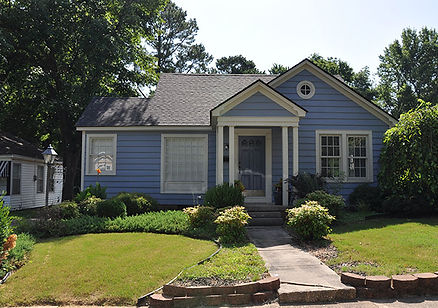
While Victorians are plentiful, the bulk of our original housing stock is the newer and quite modern bungalow inspired by the Arts and Crafts movement. The bungalow types include Arts and Crafts (515 Warner), American Bungalow, (Joe Ford's house) California Bungalow (315 E. Cherry), Spanish, (1300 W. Matthews) American Four Square (Missy Baldwin) Mock Tudor Revival (615 W. Matthews), Prairie (directly across from Warner's on Washington) and, in later years, the Ranch style inspired by the Prairie School and Frank Lloyd Wright. (Corner of Matthews and Witt).
In sharp contrast to the traditional temple form, bungalows are more horizontally oriented, which is emphasized by longer overhangs and shallower roof pitches. Large porches extend living areas out into the natural gardens that surround the home allowing the owners to enjoy nature even while indoors. (The Mock Tudors of the 1920's and 1930's are a notable exceptions to this rule). Support timbers such as rafters and eave brackets are often exposed and have decorative designs cut on their ends. Exterior wood is stained, and humble brick, wood, and stucco used in natural, earthy colors. Most houses originally had wood shake shingles that might be stained red or green. Porch posts become almost like tree trunks in some cases and are sunk down into the earth rather than sitting up on porches or verandas as in the past. Many built-ins are incorporated into the interior design to make the houses efficient and to show off the handwork of the craftsmen. Nearly all interior wood is stained or left natural. Fancy crown moldings and overdone woodwork is abandoned for more natural and humble interior finishes. Nature, authenticity, honesty and craftsmanship are kings during this revolutionary period of architecture.

What caused this major shift? The Arts and Crafts movement began in England as a rebellion against the proliferation of shoddy, mass produced factory goods. That movement changed the world of architecture and design, and interestingly is undergoing a resurrection. By the mid 1800's in England factories had put many craftsmen out of business making it more difficult to find good craftsmen and for working people to afford an authentic handmade home or other items. There was a disconnect between physical labor and the end product that the founders of the movement feared would lead to a sort of moral decline as the dignity of work and the honesty of the end product was compromised by the division of labor. Making homes (and furniture) out of humble, honest, good quality materials would again bring homes within the affordable range of the craftsmen who would build them and it would restore dignity to handwork in general. To find out more about why the West End looks the way it does, please research the names John Ruskin and William Morris.
Obviously authenticity was the primary language of the new architecture. Homes would no longer be made of fine, slick, formal materials and have their structures covered and painted to emulate Greek marble temples. They would be built out of local brick, timber and stucco. They would be brought down closer to the earth and their colors would reflect these things. Doesn't that sound refreshing?

Today, once again people are longing for a return to authentic, hand made goods, furniture and homes. Unfortunately we are at a tie in history when these are not available to most people, nor will it become available in the near future. The longing for authenticity is apparent however as most building products are doing their best to emulate actual wood. Even ceramic tile is made to look like barn wood today. But the old growth timber that could stand up to the weather and repeated paintings is gone. The craftsmen and women are no longer available to do the work, and the few we have are so precious that their labor is beyond affordable for the typical home buyer. Also, information about architectural styles is rarely taught to architects and I would dare say is never taught to builders.
We are very fortunate to have such a large inventory of these unique and irreplaceable homes in the West End. Many of them are hiding behind layers of neglect and vinyl siding, both of which are the opposite intent of the designers and builders of these last hand crafted, authentic homes. In the West End we understand and value what we have and are working to revitalize, restore and reuse our valuable assets.